Compare · Context graphs
A context graph helps AI remember. A knowledge graph lets it reason.
Both connect what a business knows. Most context graphs are built for retrieval; a knowledge graph is built for structure. The difference is what a connection means, and what you can do with it.
What is the difference between a knowledge graph and a context graph?
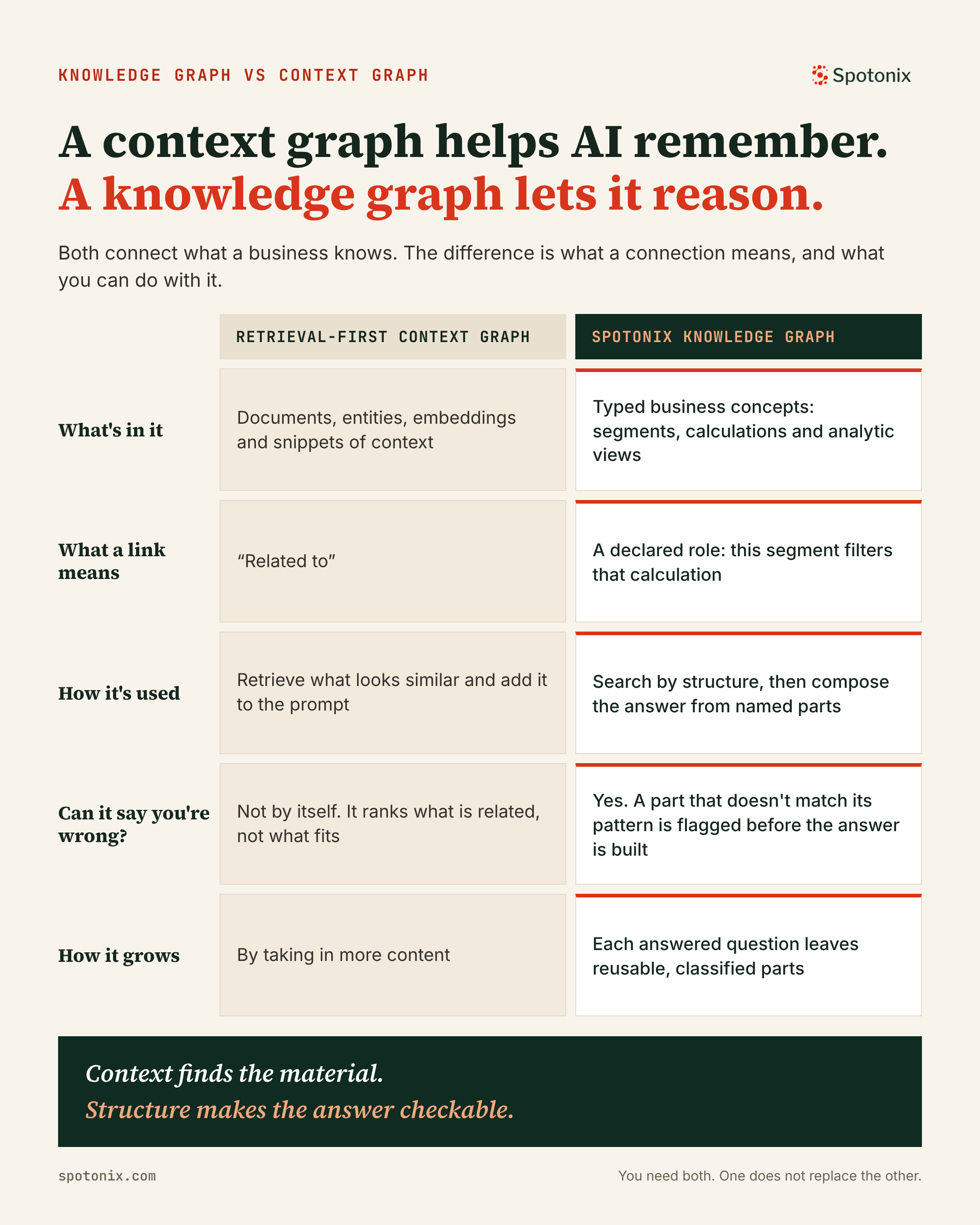
A retrieval-first context graph connects documents, entities and snippets so an AI can retrieve what looks related and add it to the prompt. The Spotonix Knowledge Graph stores typed business concepts with declared roles, so it can search by structure and compose an answer from named parts that can be checked. Context finds the material. Structure makes the answer checkable. You need both: one does not replace the other.
The difference in five rows.
Documents, entities, embeddings and snippets of context.
Typed business concepts: segments, calculations and analytic views.
“Related to.”
A declared role: this segment filters that calculation.
Retrieve what looks similar and add it to the prompt.
Search by structure, then compose the answer from named parts.
Not by itself. It ranks what is related, not what fits.
Yes. A part that does not match its pattern is flagged before the answer is built.
By taking in more content.
Each answered question leaves reusable, classified parts.
Context finds the material. Structure makes the answer checkable.
You need both. One does not replace the other.
The left column describes a typical retrieval-first design, not any one product. Many products combine both approaches.
- Download PNG2160 × 2700
- Download PDFone page
Context graphs are good at finding the material.
Keep the reasons teams build them. Retrieval over documents and usage is how an agent finds what it has not been told.
Breadth
They take in almost anything.
Documents, tickets, wikis, query history and metadata can all become context without modeling them first.
Speed
They grow by adding content.
More material usually means better recall, without waiting for someone to define every term.
Recall
They surface what looks related.
Similarity search puts relevant snippets in front of the model at the moment it needs them.
What this page does not ask you to assume.
Not a takedown
Context and structure do different jobs.
Spotonix uses retrieved context too. The Knowledge Graph adds the structure that lets an answer be composed and checked.
Typical, not universal
Products mix both approaches.
Some context layers add certified definitions or typed metadata. Compare the configured product, not the label.
Test it
Ask a question in new words.
See whether the system finds earlier work by its shape, and whether it can tell you a step does not fit.
Field notes on this comparison
Longer write-ups behind the evaluation criteria above.
Nov 4, 2026
We Already Have a Semantic Layer
The strongest objection I heard in October was polite and fair: we already have a semantic layer, and our agents are connected to it. Where that holds, where it stops, and a test you can run on your own setup this week.
Oct 7, 2026
What a Reviewable Analysis Plan Must Show
Before SQL runs, a business reviewer should be able to inspect seven parts of the intended analysis—without reverse-engineering the query.
Sep 30, 2026
The Failure That Starts Before SQL
Wrong fields, unexplained choices, and silent interpretation changes can begin before query generation—when the intended analysis was never made explicit.
Bring a question your team has answered before.
Ask it in new words. Check whether the answer reuses the earlier work, shows its parts, and flags a step that does not fit.
Book DemoSee how it works