Product · Knowledge Graph
Three ideas under every answer. Shown on one real question.
The Spotonix Knowledge Graph is a typed model of your business. An ontology says what each term means, classification finds earlier work by its shape, and an algebra composes the answer from parts that already exist.
One question. Three ideas.
Read it in 30 seconds, or download it as a one-page PDF or PNG to share.
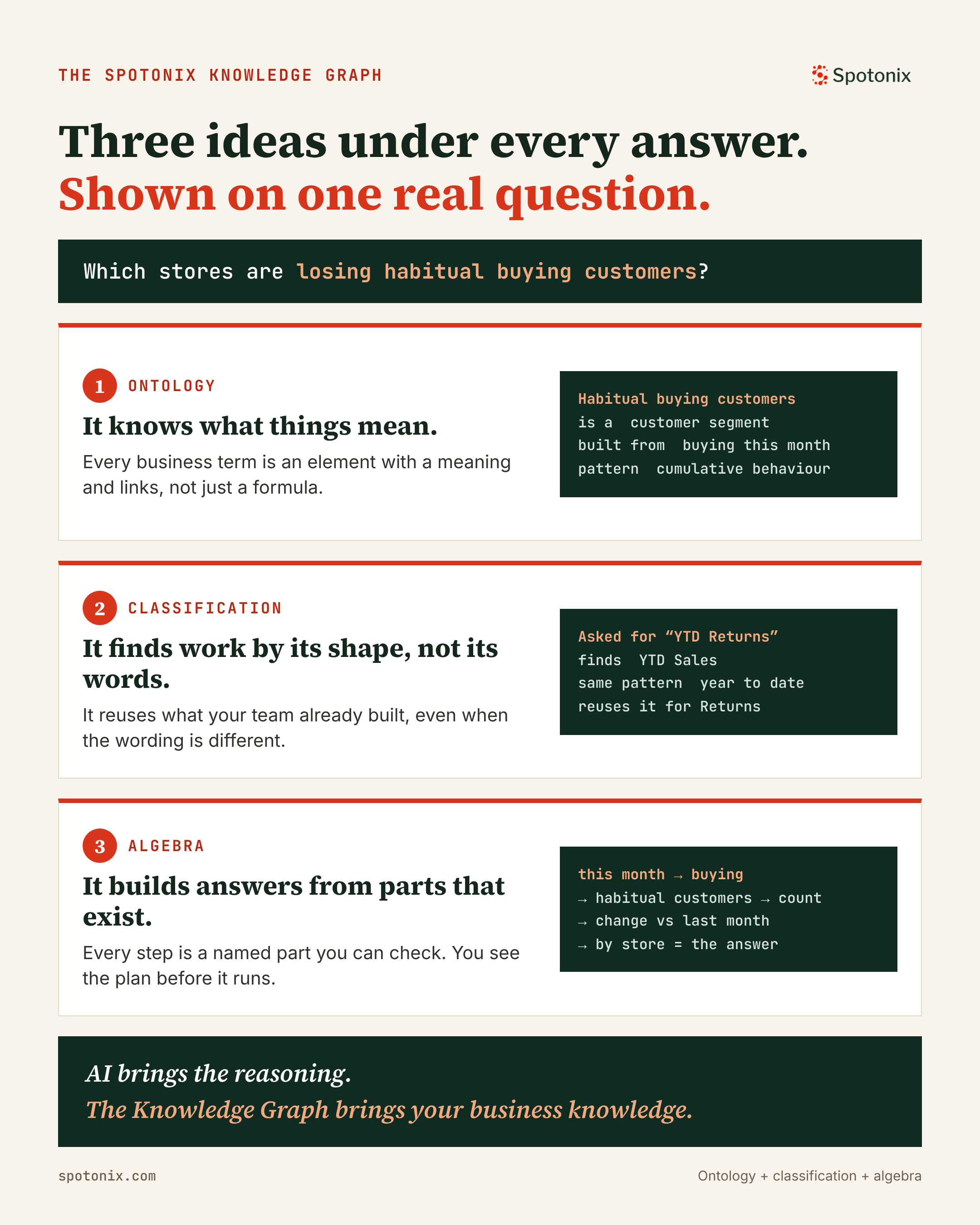
The questionWhich stores are losing habitual buying customers?
-
1Ontology
It knows what things mean.
Every business term is an element with a meaning and declared links, not just a formula.
Habitual buying customers
- is a
- customer segment
- built from
- buying this month
- pattern
- cumulative behaviour
-
2Classification
It finds work by its shape, not its words.
It reuses what your team already built, even when the wording is different.
Asked for “YTD Returns”
- finds
- YTD Sales
- same pattern
- year to date
- reuses it for
- Returns
-
3Algebra
It builds answers from parts that exist.
Every step is a named part you can check, and you see the plan before it runs.
Composed, step by step
- step 1
- this month → buying
- step 2
- → habitual customers → count
- step 3
- → change vs last month → by store
AI brings the reasoning. The Knowledge Graph brings your business knowledge.
What it is, what it does, what you get.
Read each row left to right: what it is, what it does on a real question, and what that means for the person who has to stand behind the number. The algebra is Intent Algebra. Because the parts are reusable, teams keep analytical knowledge after a handoff.
-
The Knowledge Graph
A knowledge graph of your business
Answers new questions from parts your team already built
…so you can defend the number when someone asks how you got it.
-
Ontology
Every business term is a typed element
Knows “habitual buying customers” is a segment built from this month’s buying pattern
…so the answer counts the customers your team means.
-
Classification
Work classified by its analytical shape
Asked for “YTD Returns”, reuses the YTD Sales your team already built
…so nobody rebuilds the same analysis under a new name.
-
Algebra
Answers composed from named parts
Shows the plan step by step before anything runs
…so you can check the answer before anyone acts on it.
What goes in, who can use it, and what it is not.
What it reads
Your warehouse model and BI models.
Tables, keys, measures and semantic models from supported systems in scope. Definitions from your data catalog can be brought in during onboarding. It reads them where they live; it does not replace them.
What it adds
Meaning resolved in real questions.
When your team picks or writes a definition, it becomes a typed, classified element that later questions can reuse. Creating a definition records who chose it, the options shown and when.
Who can use it
The Spotonix analyst, and other agents over MCP.
The AI analyst is the first app on the Knowledge Graph. MCP-compatible agents, such as Claude, can query the same business knowledge, so meaning is defined once.
Not a data copy
The graph does not replace the warehouse.
It represents the meaning used to interpret analysis. Retained artifacts, storage location and network boundaries are documented for each deployment.
Not model weights
Company meaning stays readable structure.
A person can read and correct an element without retraining the language model underneath.
Still worth testing
Reuse should be checked on your questions.
Test whether classification finds the right earlier work and how changed or competing definitions behave. Steward approval workflows and conflict resolution are in development.
How it compares.
Context layers, catalogs and platform agents solve real problems. These pages show where the Knowledge Graph adds to them, in a table you can read in a minute. Want all four one-pagers? Download them as one PDF.
Five rows
Knowledge graph vs context graph
Context finds the material. Structure makes the answer checkable.
Metadata vs meaning
Data catalogs
Your catalog says where the data is and who owns it. Spotonix works on what the answer means.
Snowflake
Snowflake CoCo
CoCo builds on Snowflake. Spotonix brings business knowledge agents can check.
Databricks
Genie and Genie Ontology
Ranking picks the definition. Algebra builds the answer.
The algebra
Intent Algebra
How a question becomes a plan of named, checkable steps before anything runs.
The system boundary
Architecture
What runs in your cloud, what it connects to, and what to confirm for your deployment.
Further reading
Nov 4, 2026
We Already Have a Semantic Layer
The strongest objection I heard in October was polite and fair: we already have a semantic layer, and our agents are connected to it. Where that holds, where it stops, and a test you can run on your own setup this week.
Oct 7, 2026
What a Reviewable Analysis Plan Must Show
Before SQL runs, a business reviewer should be able to inspect seven parts of the intended analysis—without reverse-engineering the query.
Sep 30, 2026
The Failure That Starts Before SQL
Wrong fields, unexplained choices, and silent interpretation changes can begin before query generation—when the intended analysis was never made explicit.
Bring a question your team has answered before.
Ask it in new words. Check whether the Knowledge Graph finds the earlier work, shows the plan and lets you defend the number.
Book DemoTalk to us first