Compare · Snowflake CoCo
CoCo builds on Snowflake. Spotonix brings the business knowledge.
Snowflake CoCo is a data-native AI coding agent for building and querying on Snowflake. The Spotonix Knowledge Graph gives agents, CoCo included, business meaning they can check. It is not either/or.
How is Spotonix different from Snowflake CoCo?
CoCo is Snowflake’s AI coding agent. It plans and runs multi-step tasks in Snowsight, a desktop app, the CLI, IDEs and over MCP, using your Snowflake catalog, lineage, access controls and semantic views, and in private preview, context learned by Cortex Sense. Spotonix is a knowledge graph of your business: an ontology says what each term means, classification finds earlier work by its shape, and an algebra composes the answer from named parts you review before it runs. CoCo helps you build on Snowflake. Spotonix makes the business answer checkable, on Snowflake or beside it.
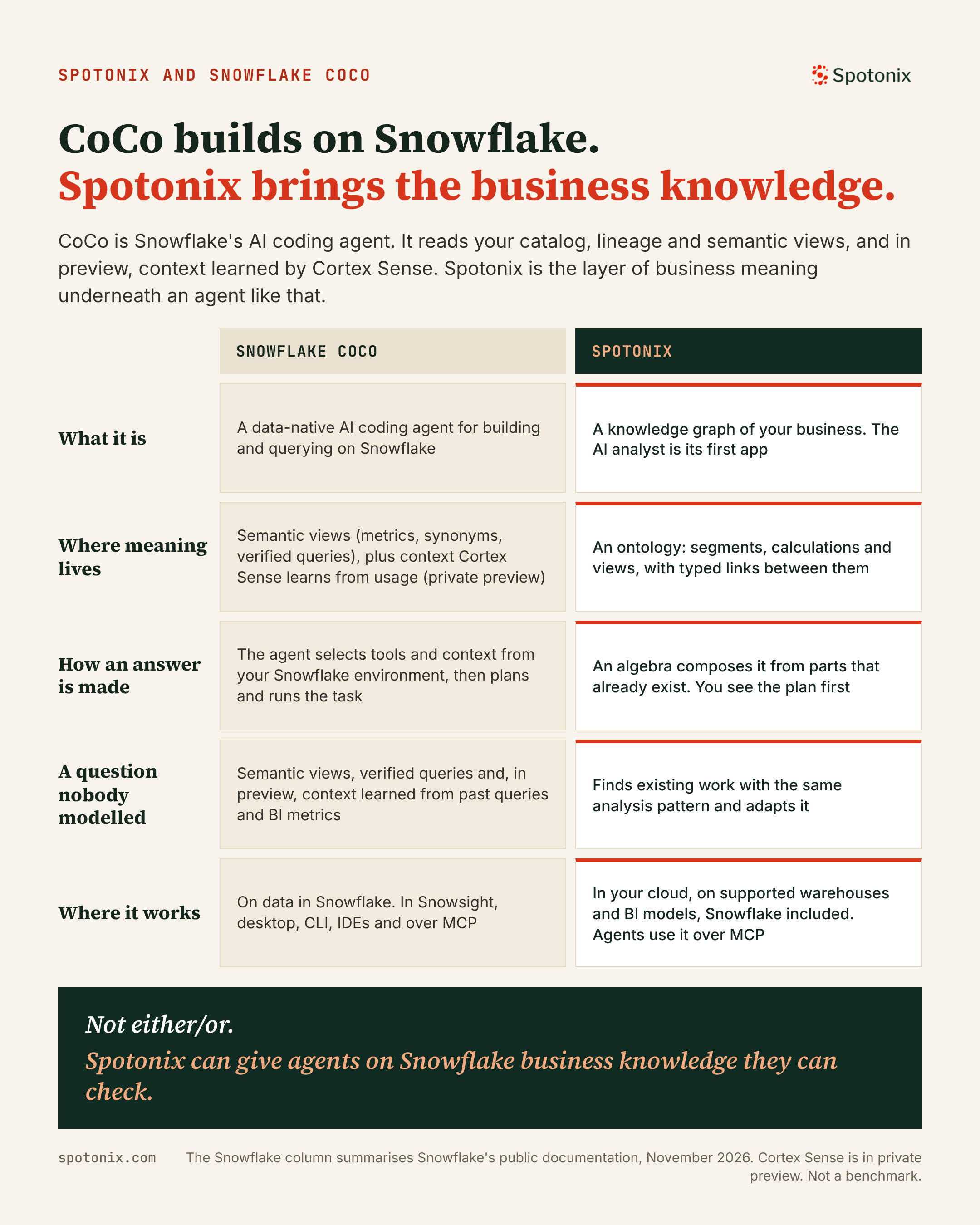
The difference in five rows.
One is an agent that builds. The other is the business knowledge an agent answers from.
A data-native AI coding agent for building and querying on Snowflake. Snowflake pairs it with CoWork.
A knowledge graph of your business. The AI analyst is its first app.
Semantic views (logical tables, relationships, metrics, synonyms and verified queries), plus the catalog, lineage and access policies CoCo can read. Cortex Sense (private preview) adds context learned from metadata and usage.
An ontology: segments, calculations and analytic views, with typed links between them.
The agent selects tools and context from your Snowflake environment, then plans and runs the task, including the SQL.
The algebra composes the answer from parts that already exist. You see the plan before it runs.
Draws on semantic views and verified queries. With Cortex Sense (private preview), it also uses context learned from past queries, dbt models and BI metrics, and asks when signals conflict.
Finds existing work with the same analytical pattern and adapts it.
On data in Snowflake. Available in Snowsight, a desktop app, the CLI, IDEs and over MCP.
In your cloud, on supported warehouses and BI models, Snowflake included. Agents can use it over MCP.
Not either/or. Spotonix can give agents on Snowflake business knowledge they can check.
The Snowflake column summarises Snowflake’s public documentation, November 2026. Cortex Sense is in private preview. Not a benchmark. Verify what is enabled in your account.
- Download PNG2160 × 2700
- Download PDFone page
CoCo is built for the people who build on Snowflake.
Start the comparison from what CoCo does well: multi-step work across the Snowflake estate, close to your data and its controls.
Where you work
It meets builders in many surfaces.
Snowsight, a desktop app, the CLI, VS Code and other editors, an MCP server, and a plugin for other coding agents.
Environment aware
It reads what Snowflake already knows.
CoCo can read your catalog, lineage and role-based access controls, and selects tools and context from your Snowflake environment.
Semantic views and Cortex Sense
It works with the semantic layer you maintain.
Semantic views hold logical tables, relationships, metrics, synonyms and verified queries. Cortex Sense, in private preview, adds context learned from metadata and usage for data nobody modeled.
What this page does not ask you to assume.
No universal winner
Fit depends on the workload and operating model.
A useful decision names the questions, users, reviewers, systems, risk, and evidence requirements in scope.
No category stereotypes
Test the configured product you can actually buy.
Use current vendor materials, enabled features, licenses, connectors, identity mode, and deployment terms.
No answer-only scorecard
Include retries, interventions, failures, and review work.
The polished final response can hide the human context reconstruction and correction required to produce it.
Official sources behind this comparison.
Reviewed November 11, 2026. Verify the current product configuration before testing.
Field notes on this comparison
Longer write-ups behind the evaluation criteria above.
Sep 30, 2026
The Failure That Starts Before SQL
Wrong fields, unexplained choices, and silent interpretation changes can begin before query generation—when the intended analysis was never made explicit.
Sep 9, 2026
What is a governed AI answer?
A governed AI answer resolves meaning against a definition your company owns and shows the plan before any query runs.
Aug 26, 2026
The Meaning Hiding Inside ‘Growing’
Words such as growing, declining, and churning hide choices about population, period, comparison, and scope—even when the metric is governed.
Run CoCo and Spotonix on the same Snowflake questions.
Use one question your semantic view covers, one with two valid business meanings, and one asked in new words for work your team already built. Record what each one asked, what you could check before the query ran, and what carried over to the next question.
Book DemoSee how it works